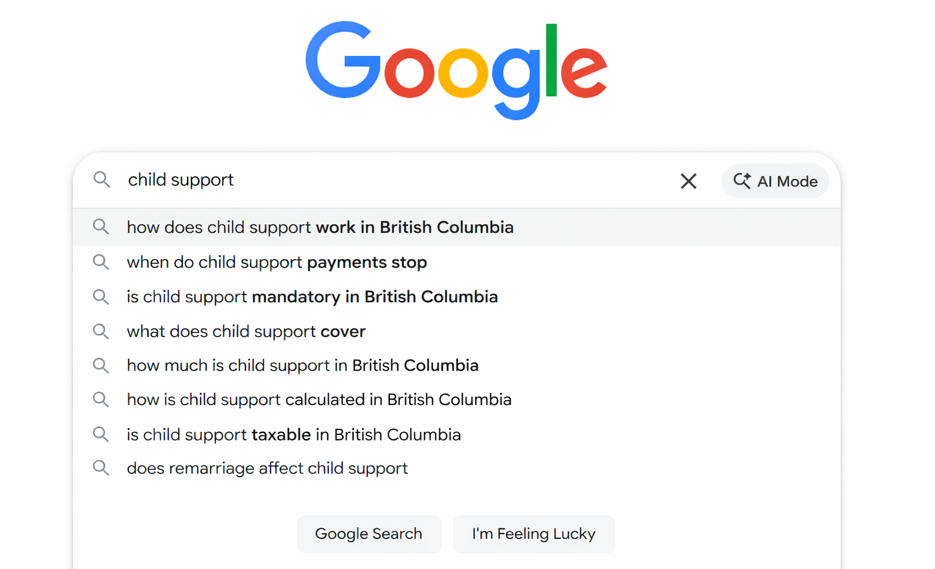
Child support remains one of the most searched and misunderstood topics in family law in 2025. As families continue to evolve, so do the questions surrounding child support. As we head into the new year, we’re answering some of Google’s most frequently asked questions about child support in British Columbia.
1. How does child support work in British Columbia?
Child support is the right of the child, and the law seeks to ensure that both parents contribute financially to their children’s care. When parents separate, one parent may be required to pay child support to the other parent to help support their children. If the children live primarily with one parent, the other parent usually pays child support. If the children spend their time with both parents equally, child support is usually paid by the parent who has the higher income.
2. When do child support payments stop?
The general rule is that the payor must continue making payments until the child reaches the age of majority, which is 19 years old in British Columbia.
However, there are exceptions to this general rule. For example, child support payments may continue after a child has turned 19, such as when the child has an illness or disability, or is attending post-secondary education. Another exception is that a parent’s obligation to pay child support may end if a child under 19 years old gets married or chooses to live with neither parent.
3. Is child support mandatory in British Columbia?
Yes, child support is mandatory in British Columbia. Children are legally entitled to financial support from both parents. However, the form that child support takes can vary from case to case.
4. What does child support cover?
Child support covers a child’s basic needs and expenses, including housing, food, clothing, and other necessities. However, some special or extraordinary costs, not included in the basic child support amount, may be shared between the parents as well. Also known as section 7 expenses, this may include childcare expenses, medical or dental expenses, and extracurricular activities. Section 7 expenses are generally shared between parents in proportion to their incomes.
5. How much is child support in British Columbia?
There is no fixed amount for child support in British Columbia. Child support is calculated using the Federal Child Support Guidelines, which depends on how much the payor’s income is and the number of children the two parents have together.
6. How is child support calculated in British Columbia?
As mentioned previously, child support is calculated using the Federal Child Support Guidelines. The Federal Child Support Guidelines provide tables for each province and territory in Canada, setting out the basic amount of support a parent should pay.
To calculate child support, you should select the table that matches how many children you share with the other parent of your children. You will then need to determine the payor’s annual gross income. Using the appropriate table, you can then find the monthly child support amount based on the payor’s annual gross income. In practice, determining a payor’s income can require consideration of a range of factors, including, tax treatment of different forms of income, deductible expenses, and, in some cases, corporate structures.
If each parent has the children 40% or more of the time, this is considered a shared parenting arrangement and the rules for calculating child support change. In such situations, you should identify the set-off amount, which is the difference between the basic child support amount each parent would pay if the children lived solely with the other parent. Each parent calculates the amount they would pay based on their income, and the difference between the two amounts is the set-off amount. A judge then has discretion to order the set-off amount or adjust child support based on other factors.
Finally, the payor may also be required to pay special or extraordinary expenses, also known as section 7 expenses, which are child-related costs that are not covered by the basic child support amount in the guidelines. This may include childcare, health-related expenses, and extraordinary extracurricular activities. These expenses are to be paid in addition to the basic child support amount and are generally shared between both parents in proportion to their incomes.
7. Is child support taxable in British Columbia?
No, you do not pay income taxes on child support received from your former spouse or partner. Likewise, if you’re the one paying child support, you do not deduct your payments from your taxable income.
8. Does remarriage affect child support?
Generally, no, if the parent receiving child support remarries, this does not affect child support. The responsibility of paying child support lies with the child’s parents, and not the new partner.
However, there are circumstances where the new partner’s income may be relevant. In some situations, the court may consider the standard of living in each parent’s household, which may include the new spouse’s income. One example of this is where the parents have shared parenting time of the children. As mentioned previously, child support is calculated using the “set-off” formula as a starting point. However, the court may also consider the circumstances of each spouse, which may include the new partner’s income. Again, this does not mean the new partner is obligated to pay child support.
Additionally, while remarriage itself does not generally affect child support, separating from a stepparent of a child can. An obligation of a stepparent to pay child support only arises if the stepparent has contributed to the child’s support for at least one year and a claim for child support is commenced within one year of their last contribution. Any obligation of a stepparent to pay support is secondary to that of the child’s parents.
Conclusion
Child support continues to raise important questions for parents. As parents, it is important to understand how child support works so that you can ensure that your children are receiving the care they need. If you need advice on child support issues, please contact Mackenzie Do, Ty Bradford, Matthew Ostrow, or any member of our Family Law Group to inform you of your legal rights and obligations.